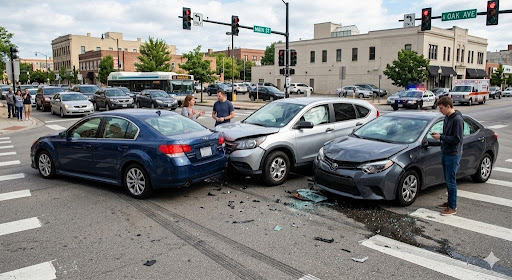
Three Drivers, One Intersection, and Nobody Wants to Be the Defendant
When the Story Gets Complicated Before the Tow Truck Arrives
Picture this: a four-way intersection on a Tuesday morning. Driver A stops short. Driver B rear-ends them. Driver C, following too close behind B, slides into the back of that collision. Three vehicles. Three different stories. And within hours, someone in a comment thread has already declared that “the rear driver is always at fault, end of story.”
That sentence is one of the most damaging oversimplifications in circulation right now.
I’ve spent years reviewing intersection crash reports and insurer letters, and I can tell you it’s not just wrong in many multi-vehicle situations — it actively discourages people from advocating for themselves because they assume the outcome is already written. If you’re reading this after a three-car or chain-reaction crash, here’s what I want you to understand first: your situation is fact-specific. The details of what happened to your vehicle, at what speed, with what road conditions, and in what sequence matter enormously. No shortcut judgment can replace that investigation — and you have every right to participate in it.
How Fault Actually Gets Divided: The Framework You Need
Negligence Is the Starting Point, Not the Ending Point
The legal concept that drives fault allocation in any car accident is negligence. At its core, negligence means a driver failed to exercise reasonable care — following too closely, running a yellow light, checking a phone — and that failure caused harm.
In a multi-vehicle accident, the question isn’t simply “who hit whom.” It’s “which driver or drivers failed to act reasonably, and how did each failure contribute to the overall crash?” That distinction matters because in a three-car pileup, you may have two or even three drivers who each made a mistake. The law doesn’t require a single villain. It asks how much each party’s negligence contributed to the damages.
Comparative Negligence at a Glance
Most states — including Massachusetts — use some form of comparative negligence. Here’s how the core concepts interact:
| Term | What It Means | Why It Matters in Multi-Vehicle Crashes |
|---|---|---|
| Comparative negligence | Fault is distributed across parties by percentage | Multiple drivers can each owe a share |
| Modified comparative negligence | Recovery is barred above 50% fault | Your assigned percentage has direct financial stakes |
| Liability | Legal responsibility to compensate for harm | Follows negligence, not who filed first |
| Damages | Medical bills, lost wages, pain and suffering | The full picture often takes months to emerge |
Under Massachusetts’ modified comparative negligence rule, a plaintiff — the person seeking compensation — can recover damages as long as they are not more than 50% at fault. Once you cross that threshold, recovery is barred entirely. That’s why the percentage assigned to each driver isn’t just academic.
This is also where the “rear driver is always at fault” myth falls apart in chain-reaction crashes. Driver C, who hit Driver B, may bear significant fault. But if Driver B was following Driver A at an unsafe distance before stopping, B carries some negligence too. And if Driver A stopped suddenly for no legitimate reason, A may hold a share as well. Three drivers. Three potential contributors. One percentage pie.
How Insurance Companies Actually Evaluate Multi-Vehicle Crashes
What Happens After You Call Your Insurer
After a multi-car crash, your first call should be to your own insurance company to open a claim — even if you believe another driver was primarily at fault. Delaying that contact can create complications later.
What happens next is often misunderstood. The insurer doesn’t simply take the police report at face value and write a check. Adjusters investigate. They review the police report, request recorded statements, examine vehicle damage patterns, and sometimes hire accident reconstruction specialists. Each insurer — yours, Driver B’s, Driver C’s — is doing this simultaneously, often reaching different preliminary conclusions.
The Gap Between “Initial Decision” and “Final Determination”
One of the most common fears I hear: “The insurance company already decided it was my fault — is that it?”
No. That’s rarely it.
An initial fault determination from an adjuster is a starting position, not a final judgment. If you disagree, you can — and should — provide additional evidence: your own photos from the scene, witness contact information, dashcam footage, medical records, and a written account of the sequence of events as you experienced them. State law governs how insurers must handle disputes, and in Massachusetts, there are specific regulations about fair claims handling that give you procedural rights.
The insurer’s job is to assess liability based on available facts. Your job is to make sure your facts are in the file.
When Multiple Insurers Disagree
In a three-car crash, you may have three separate insurers making three different assessments. Insurers sometimes enter into inter-company arbitration to resolve disputes about which carrier owes what — a process that happens largely out of your view but directly affects your claim.
If you’re a plaintiff in this scenario — meaning you suffered injuries or property damage and are seeking compensation — the multi-insurer dynamic is exactly why having a boston car accident lawyer review your situation early can prevent you from accepting a settlement that doesn’t reflect the full picture of what happened.
The Timeline: How Fault Gets Established Over Weeks, Not Hours
Most people expect a resolution in days. The reality looks more like this:
The First 72 Hours — Documentation, Not Declarations
At the scene, if you’re physically able: photograph all vehicles from multiple angles, capture road conditions and traffic signals, and collect contact and insurance information from every driver and witness. Don’t make statements about fault to anyone other than police. The police report generated at the scene is important, but it’s not the final word — officers work quickly and without full information, and errors in those reports can be challenged with supplemental evidence.
Weeks One Through Four — Parallel Investigations
This is when insurer investigations run simultaneously. Adjusters contact drivers, request statements, and assess vehicle damage. Medical treatment records begin accumulating. During this period, be careful about recorded statements to other drivers’ insurers. You’re not required to give one without consulting counsel first, and what you say can be used to assign you a higher percentage of fault.
When the Case Moves Toward Litigation
If insurer negotiations stall or fault percentages remain disputed, the matter may move toward a formal legal process. The roles of plaintiff and defendant become more defined. The plaintiff bears the burden of proving the defendant’s negligence caused their damages. The defendant — or their insurer — argues that the plaintiff’s own negligence contributed or that damages are overstated.
One hard deadline worth knowing: the statute of limitations for filing a claim in Massachusetts is generally three years from the date of the accident. Missing that window forfeits your right to recover, regardless of how clear the other driver’s fault may be.
“But the Other Driver’s Insurer Already Told Me I Was at Fault”
This comes up constantly.
An adverse insurer — the insurance company for the driver who hit you — has a financial interest in minimizing what they pay out. Their initial fault assessment reflects that interest. It is not a neutral judicial finding.
You have the right to dispute it. You can submit your own evidence, request the basis for their determination, and if necessary, file a complaint with your state’s Division of Insurance if you believe the insurer is acting in bad faith. None of this requires you to be combative. It requires you to be organized and persistent.
What to Gather Before You Talk to Anyone
You don’t need to be a lawyer to protect your position. You need to be methodical.
In the days following a multi-vehicle accident, focus on collecting these specific items — and keep them in one place:
- The full police report — not just the incident number, the actual report
- Photos and video from the scene, including any traffic or business cameras nearby
- Contact information for all witnesses, not just the other drivers
- A written timeline of events as you remember them, drafted while memory is fresh
- All medical records and bills related to injuries from the crash
- Documentation of missed work or other economic losses
When you eventually speak with your insurer or an attorney, having organized records changes the dynamic of that conversation entirely. You move from someone reacting to someone presenting.
Quick Reference: Common Multi-Vehicle Fault Questions
Q: If I was rear-ended, am I automatically not at fault? Not necessarily. If you stopped suddenly without cause, changed lanes unexpectedly, or had non-functioning brake lights, you may carry a share of negligence.
Q: Can all three drivers in a chain-reaction crash share fault? Yes. Comparative negligence allows fault to be distributed across every party whose negligence contributed — including drivers who weren’t the last to make contact.
Q: Does the police report determine fault? It’s one input, not the final word. Adjusters, attorneys, and courts weigh the police report alongside physical evidence, witness statements, and expert analysis.
Q: How long does fault determination take? Simple cases may resolve in weeks. Cases involving disputed liability, serious injuries, or multiple insurers can take months — and litigation can extend that further.
Where to Go From Here
If you’re still sorting through what happened and what your options are, the most useful next step is a direct consultation with someone who handles multi-vehicle accident claims in your area.
Many plaintiff-side attorneys offer free initial consultations and can tell you quickly whether the fault allocation being proposed reflects the actual evidence — or whether it’s a shortcut that deserves a harder look. The goal isn’t to turn every accident into a lawsuit. It’s to make sure the process that determines who pays what is actually based on what happened, car by car.
